Abstraction in communicating agents
Artificial agents learn to communicate abstractions. 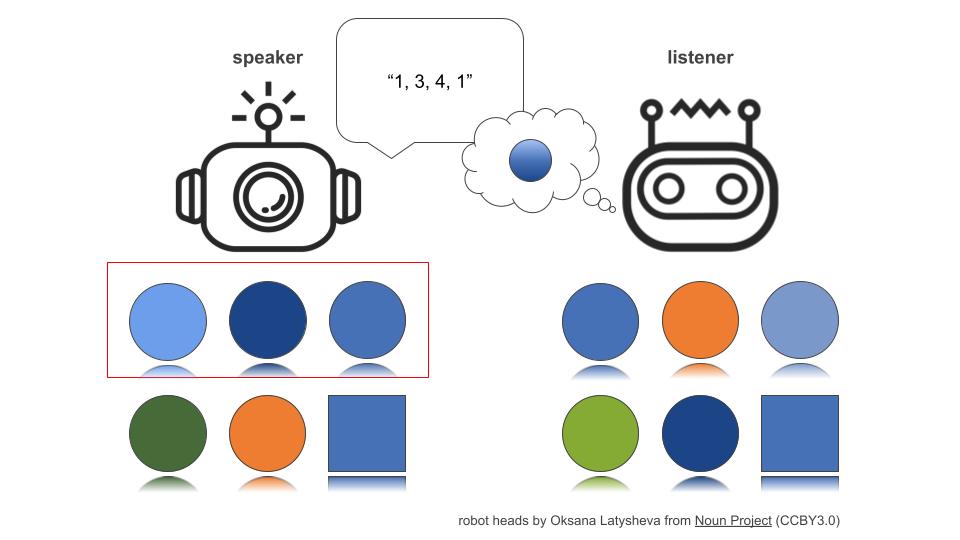

Artificial agents learn to communicate abstractions.
Analysis of the replication rate in experimental linguistics. Spoiler alert: The replication rate is super low! 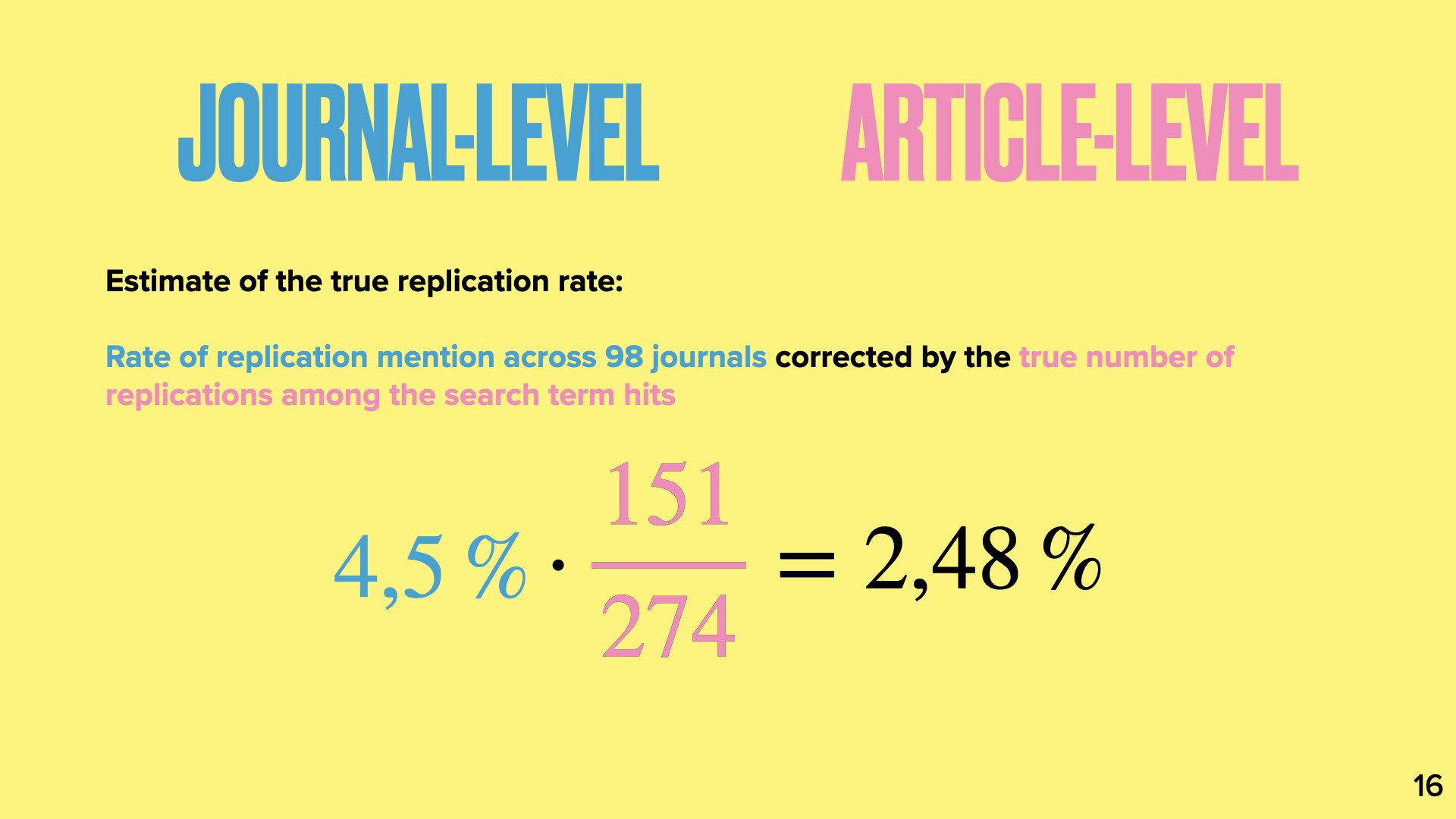
Published in Glossa Psycholinguistics, 2023
Replications are an integral part of cumulative experimental science. Yet many scientific disciplines do not replicate much because novel confirmatory findings are valued over direct replications. To provide a systematic assessment of the replication landscape in experimental linguistics, the present study estimated replication rates for over 50,000 articles across 98 journals. We used automatic string matching using the Web of Science combined with in-depth manual inspections of 274 papers. The median rate of mentioning the search string “replicat*” was as low as 1.7%. Subsequent manual analyses of articles containing the search string revealed that only 4% of these contained a direct replication, i.e., a study that aims to arrive at the same scientific conclusions as an initial study by using exactly the same methodology. Less than half of these direct replications were performed by independent researchers. Thus our data suggest that only 1 in 1250 experimental linguistic articles contains an independent direct replication. We conclude that, similar to neighboring disciplines, experimental linguistics replicates very little, a state of affairs that should be reflected upon.
Recommended citation: Kobrock, Kristina & Roettger, Timo B. (2023). “Assessing the replication landscape in experimental linguistics." Glossa Psycholinguistics. 2(1). https://doi.org/10.5070/G6011135
Published in Proceedings of the 2024 Joint International Conference on Computational Linguistics, Language Resources and Evaluation (LREC-COLING 2024), 2024
We study the communication of concepts at different levels of abstraction and in different contexts in an agent-based, interactive reference game. While playing a concept-level reference game, the neural network agents develop a communication system from scratch. We use a novel symbolic dataset that disentangles concept type (ranging from specific to generic) and context (ranging from fine to coarse) to study the influence of these factors on the emerging language. We compare two game scenarios: one in which speaker agents have access to context information (context-aware) and one in which the speaker agents do not have access to context information (context-unaware). First, we find that the agents learn higher-level concepts from the object inputs alone. Second, an analysis of the emergent communication system shows that only context-aware agents learn to communicate efficiently by adapting their messages to the context conditions and relying on context for unambiguous reference. Crucially, this behavior is not explicitly incentivized by the game, but efficient communication emerges and is driven by the availability of context alone. The emerging language we observe is reminiscent of evolutionary pressures on human languages and highlights the pivotal role of context in a communication system.
Recommended citation: Kobrock, Kristina, Ohmer, Xenia, Bruni, Elia & Gotzner, Nicole (2024). “Context Shapes Emergent Communication about Concepts at Different Levels of Abstraction.” Proceedings of the 2024 Joint International Conference on Computational Linguistics, Language Resources and Evaluation (LREC-COLING 2024). https://aclanthology.org/2024.lrec-main.339.pdf
Published in Proceedings of the Annual Meeting of the Cognitive Science Society 2024, 2024
We study referential communication about concepts at different levels of abstraction in an interactive concept-level reference game. To better understand processes of abstraction, we investigate superordinate referring expressions (animal). Previous work identified two main factors that influence speakers’ choice of referring expressions for concepts: the immediate context and the basic-level effect, i.e. a preference for basic-level terms such as dog. Here we introduce a new concept-level reference game that allows us to study differences in the basic-level effect between comprehension and production and to elicit superordinate referring expressions experimentally. We find that superordinate referring expressions become relevant for groups of objects. Further, we reproduce the basic-level effect in production but not in comprehension. In conclusion, even though basic-level terms are most readily accessible, speakers tailor their expressions to the context, allowing the listener to identify the target concept.
Recommended citation: Kobrock, Kristina, Uhlemann, Charlotte & Gotzner, Nicole (2024). “Superordinate referring expressions in abstraction: Introducing the concept-level reference game.” Proceedings of the Annual Meeting of the Cognitive Science Society 2024. https://osf.io/cv74u
Published in Findings of the Association for Computational Linguistics: ACL 2025, 2024
We study abstraction in an emergent communication paradigm. In emergent communication, two artificial neural network agents develop a language while solving a communicative task. In this study, the agents play a concept-level reference game. This means that the speaker agent has to describe a concept to a listener agent, who has to pick the correct target objects that satisfy the concept. Concepts consist of multiple objects and can be either more specific, i.e. the target objects share many attributes, or more generic, i.e. the target objects share fewer attributes. We tested two directions of zero-shot generalization to novel levels of abstraction: When generalizing from more generic to very specific concepts, agents utilized a compositional strategy. When generalizing from more specific to very generic concepts, agents utilized a more flexible linguistic strategy that involves reusing many messages from training. Our results provide evidence that neural network agents can learn robust concepts based on which they can generalize using adaptive linguistic strategies. We discuss how this research provides new hypotheses on abstraction and informs linguistic theories on efficient communication.
Recommended citation: Kobrock, K., Ohmer, X., Bruni, E., & Gotzner, N. (2024). “Agents can generalize to novel levels of abstraction by using adaptive linguistic strategies.” submitted to ARR. https://doi.org/10.18653/v1/2025.findings-acl.455
Published in Frontiers in Psychology, Section Cognitive Science, 2024
Approach and avoidance behaviors have been extensively studied in cognitive science as a fundamental aspect of human motivation and decision-making. The Approach-Avoidance Bias (AAB) refers to the tendency to approach positive stimuli faster than negative stimuli and to avoid negative stimuli faster than positive ones. Affect and arousal in involved individuals are assumed to play a crucial role in the AAB but many questions in that regard remain open. With this in mind, the present study aimed to examine the impact of positive and negative mood on the AAB. To achieve this goal, we conducted an experiment where participants watched either positive or negative videos prior to performing an approach-avoidance task. We have not been able to confirm our preregistered hypothesis that mood induction moderates the AAB. Instead, our results suggest that an AAB can be robustly shown after both the positive and the negative intervention. Positive Affect Negative Affect Schedule (PANAS) results show that the participants' affective state was influenced by the mood intervention only in the form of increased emotional intensity. Participants did not self-report a change in mood valence that corresponds to the valence of the video primes. However, the behavioral data shows that after watching a positive video, participants are faster in approaching positive stimuli than negative stimuli. At the same time, we do not find a similar effect after the negative intervention. These findings suggest that positive and negative affect might play an important role in shaping the AAB that is modulated by stimulus valence. This provides new potential insights into the underlying mechanisms of human motivation and decision-making. Specifically, we argue for potential differences between attention and reaction toward a valenced stimulus.
Recommended citation: Kobrock, Kristina, Solzbacher, Johannes, Gotzner, Nicole and König, Peter (2024). “Feeling good, approaching the positive.” Frontiers in Psychology. 15. https://doi.org/10.3389/fpsyg.2024.1491612
Published in submitted to ACL Rolling Review, 2025
We investigate how context granularity, i.e. whether fine or coarse distinctions need to be made, influences an emerging lexicon. We conduct an agent-based simulation of a concept-level reference game, in which agents learn to communicate about concepts that are operationalized by combining multiple objects. We create three experimental conditions by manipulating the context in which the instances of the target concept appear: In the fine context condition, agents must make precise distinctions between similar targets and distractors. In the coarse context condition, targets are easy to discriminate because they share no overlapping features with the distractors. In the mixed baseline condition, both fine and coarse distinctions are necessary. Our results suggest that agents adapt their communication strategies to the granularity of the context in which they learned the concepts. In the fine context and baseline conditions, agents develop a communication protocol heavily based on one-to-one mappings between messages and concepts. Conversely, in the coarse context condition agents communicate more efficiently by vastly relying on abstract references that may refer to more than a single concept but are unambiguous in context. These results show that ambiguity emerges in coarse contexts and that ambiguous abstract terms are used for more efficient communication.
Recommended citation: Briotto, Anna, Kobrock, Kristina & Bruni, Elia (2025). “The Efficiency of Ambiguity: Abstract References Emerge in Coarse Contexts.” submitted to ARR. https://doi.org/10.31234/osf.io/3btvj_v2
Published in PLOS Computational Biology, 2026
We model pragmatic mechanisms of referential communication and categorization in a multi-agent framework of emergent communication. Pragmatic theories and experimental work predict that speakers consider the context in their choice of referring expressions. In addition to this context-based reasoning, utility-based pragmatic reasoning about the listener’s likely interpretation of an utterance influences the speaker’s production choices. We aim to investigate these two factors and their role in referring expression generation and categorization in a computational model of language emergence and language use. We model communication in interaction and consider an efficiency tradeoff between speaker and listener utilities. Our results show that an emerging language becomes more effective, ambiguous, and efficient when speakers and listeners communicate in a shared context. This is achieved by an efficient tradeoff between production and comprehension where languages can afford to be simpler in production when they are sufficiently informative in context, placing more burden on the listener’s side. We further demonstrate that incorporating utility-based pragmatics, as modeled with the Rational Speech Acts framework, improves the linguistic efficiency of language use only in languages that emerged with a shared context between interlocutors, but not in languages that emerged without such contextual information during training. We conclude that context-based pragmatics plays a role in referential communication and categorization by shaping an emerging language. Efficient reference in a communicative situation can benefit especially from utility-based pragmatics if the language that is being used has emerged in context. This might suggest that utility-based pragmatics hinges on mechanisms that naturally emerge when context is available during the evolution of a language. In summary, we show that human-like language and category systems emerge as an optimized tradeoff between speaker and listener needs in interaction, i.e., under efficiency considerations of simplicity and informativeness.
Recommended citation: Kobrock, K., Ohmer, X., Bruni, E., & Gotzner, N. (2026). The role of pragmatic mechanisms in referential communication and categorization: An emergent communication model. PLOS Computational Biology, 22(5), e1014326. https://doi.org/10.1371/journal.pcbi.1014326 https://journals.plos.org/ploscompbiol/article?id=10.1371/journal.pcbi.1014326
Published in submitted to Cognitive Science, 2026
We investigate how context granularity, i.e. whether fine or coarse distinctions need to be made, influences an emerging lexicon. We conduct an agent-based simulation of a concept-level reference game, in which agents learn to communicate about concepts that are operationalized by combining multiple objects. We create three experimental conditions by manipulating the context in which the instances of the target concept appear: In the fine context condition, agents must make precise distinctions between similar targets and distractors. In the coarse context condition, targets are easy to discriminate because they share no overlapping features with the distractors. In the mixed baseline condition, both fine and coarse distinctions are necessary. Our results suggest that agents adapt their communication strategies to the granularity of the context in which they learned the concepts. In the fine context and baseline conditions, agents develop a communication protocol heavily based on one-to-one mappings between messages and concepts. Conversely, in the coarse context condition agents communicate more efficiently by vastly relying on abstract references that may refer to more than a single concept but are unambiguous in context. These results show that ambiguity emerges in coarse contexts and that ambiguous abstract terms are used for more efficient communication.
Recommended citation: Briotto, Anna, Kobrock, Kristina & Bruni, Elia (2025). “The Efficiency of Ambiguity: Abstract References Emerge in Coarse Contexts.” submitted to ARR. https://doi.org/10.31234/osf.io/3btvj_v2
Published:
Published:
Published:
Published:
Published:
Published:
B.Sc./M.Sc. Course, Osnabrück University, Institute of Cognitive Science, 2021
This course was co-taught by five master students.
Class in Lecture: Introduction to Data Analysis, Osnabrück University, Institute of Cognitive Science, 2023
Lecture in Course: Psychosemantics (Taught by Nicole Gotzner), Osnabrück University, Institute of Cognitive Science, 2023
Block course, Osnabrück University, Institute of Cognitive Science, 2025